
The subject of water hardness (or softness) is often very confusing and people tend to shy away from trying to understand it. We will try to go through it as simply as possible to help you understand the topic.
Let’s face it, we’re trying to keep tropical fish here, not earn ourselves a degree in science!
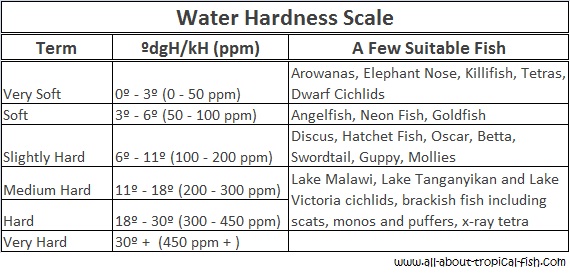
Water hardness will differ from source to source and you may wish to choose your fish to suite the water in your area. Yes, as with PH, fish are suited to different levels of hardness and can be divided into categories, which we will go through later.
In the long run you will save yourself some hassle, but at the same time you shouldn’t forget that your water supply can change without notice.
Keep your test kit handy!
Description:
Water Hardness can be explained as the level of minerals, or dissolved solid materials, contained in the water. The higher the level of minerals the higher the hardness will be. Very soft water will have low levels of these dissolved minerals.
For those who really want to know, these materials consist mainly of calcium and magnesium ions, bicarbonates and sulfates. Their common sources are limestone, chalk, dolomite and other solid materials that the water has come into contact with before it reaches our taps.
Most people will know if the water is generally hard in their area. You can tell this if you gets lots of scaling left behind in your kettle or around your water taps at home.
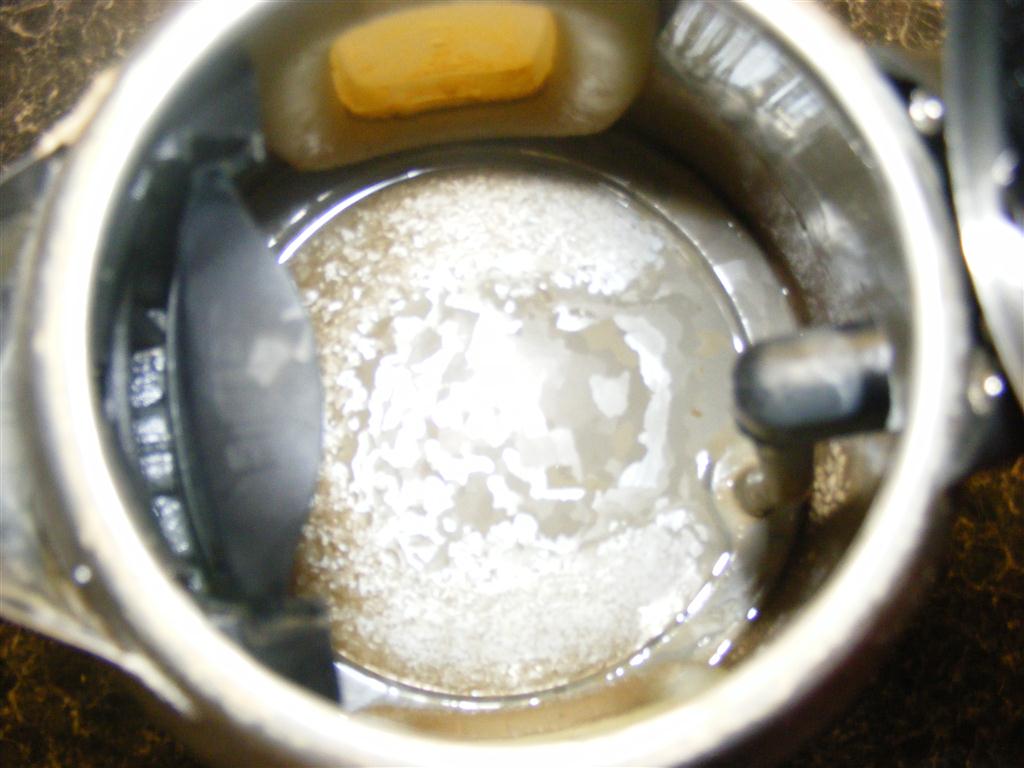
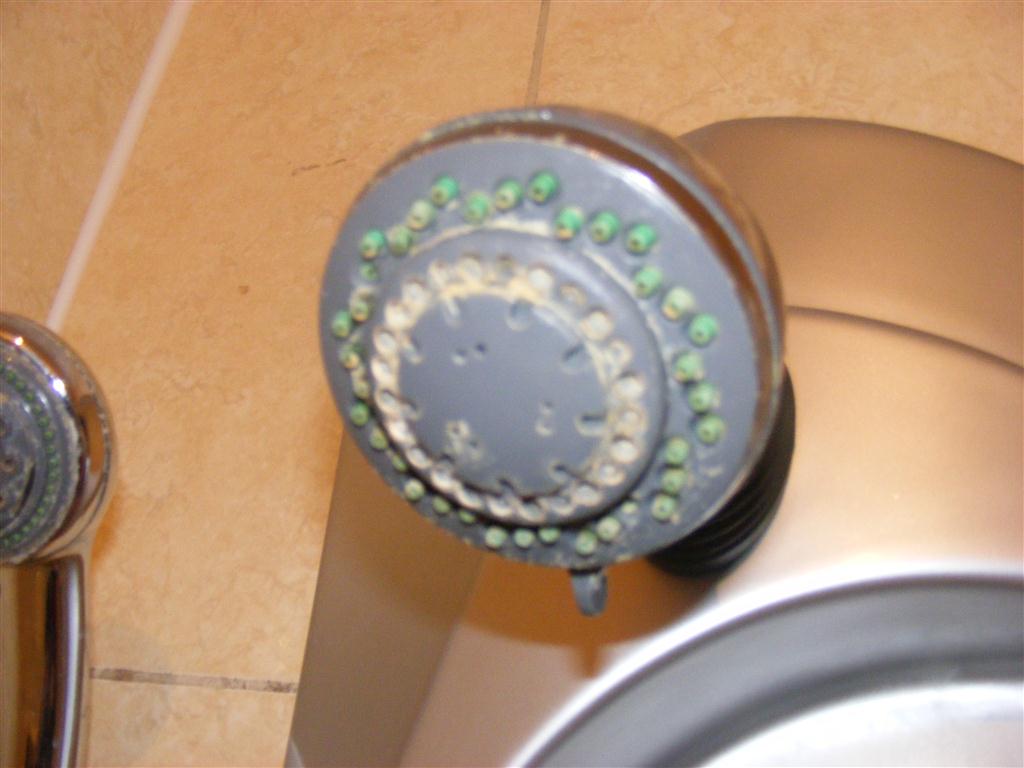
Above are pictures showing hard water build-up, one in the kettle and the other is the shower head. Yes, I wouldn’t drink out of that kettle either now that I’ve looked inside it!
Hard water can be broken up into 2 categories; Carbonate Hardness (KH) and General Hardness (GH).
Carbonate Hardness (KH)
Carbonate hardness is better known as Temporary Hardness. It is used to describe hardness that can be removed or reduced by boiling the water.
Calcium Carbonate is removed from water during boiling. An example of this can be seen above when we spoke about scale residue being left inside your kettle. After the water has cooled down it will be noticeably softer.
Remember
Carbonate water hardness helps to stabilize the aquarium PH and helps prevent shock changes that can be detrimental to your fish. This is also known as ‘Buffering Capacity’. So don’t get too excited and start boiling all your water until you have explored all your options.
General Hardness (GH)
General Hardness is also known as Total Hardness. General hardness refers to the level of calcium and magnesium in the water.
Another name for this is ‘Permanent Hardness’, but I don’t think the name really fits. While these elements cannot be removed by boiling the water, there are other ways to remove them. This means it’s not really permanent.
Measuring Hardness
Here comes another tricky part! The units used for measuring hardness are different from country to country. Your best bet is to go by the instructions on your water testing kit.
They talk about degrees of hardness. This would be written as °kH or °gH. The problem comes in where different you get German degrees, American degrees, English degrees and even French degrees.
Now they may all be in degrees, but the formulas used to work them out are not the same. Some of them may be very similar though.
The measurement for water hardness I prefer is Parts Per Million (ppm) . It’s much easier to understand and basically means milligrams of calcium carbonate per litre of water. This seems to be the most popular way of measuring hardness as is widely used.
Adjusting Water Hardness
If your water is either very hard or very soft, you may feel the need to change it. It is pretty easy to do, but there are a few things to consider though.
Is it really necessary? If you are having problems with your fish, then this may be something you want to look into. Adjusting the KH (carbonate hardness) can lower your fish tanks resistance to changes in the PH. You must be willing to monitor this. You should also remember that while most fish will have a recommended hardness range, many of them can survive in most conditions. Some are just more resistant than others and some have adapted over time through being bred in aquariums.
Soft Water Treatment
Soft water treatment to increase the hardness in your tank can be done in a number of ways. The most common would be to add something to your tank that is limestone based i.e. decorations or lime sand or coral gravel which could be added into your filter.
You can also buy hardening treatments from your pet store to increase hardness. Always read the instructions on the packaging and use together with your test kit.
It is important to only make small changes at a time. Drastic changes can harm your fish and even kill them. Your small water changes should also be happening at very regular intervals, this will help you keep the balance in your aquarium.
Hard Water Treatment
Most people tend to have the problem of hard water and the use of water softeners is more common than water hardeners.
As with increasing hardness, there are also a number of ways to decrease hardness. These range from reasonable cheap and easy methods to buying expensive equipment to do the job.
One method is to dilute hard water with soft water from another source. The trick here is getting the soft water! Some people use deionized water or distilled water to dilute their tap water and bring the hardness levels down.
You may want to look into using a reverse osmosis water filter. Although this process is the one I was referring to as being expensive and should probably be left to the enthusiasts with a few years of experience under their belt.
Then we have the boiling method to remove the temporary or carbonate hardness (KH). While many people will jump at this idea, we must remember that a low KH can cause PH problems. Boiled water will also need to be aerated extensively before being put into the aquarium. Boiling the water removes all the oxygen from inside it.
Now we come to my recommended method, the water softener pillow . These pillows are readily available and are quite simple to use. They contain a resin which chemically absorbs the hardness out of the water. The resin can only hold a certain amount of hardness, so they need to be changed or cleaned. You will need to read the instructions on the packaging for your product to find out exactly how to use it.
Wikipedia has a good page on Hard Water if you really want to know about the in-depth terms and technical details.(page opens in a new window)
Always make small changes! Whether it be raising or dropping hardness, or doing water changes. You don’t want to shock your fish. Keep your water testing kit handy!
Leave a Reply